
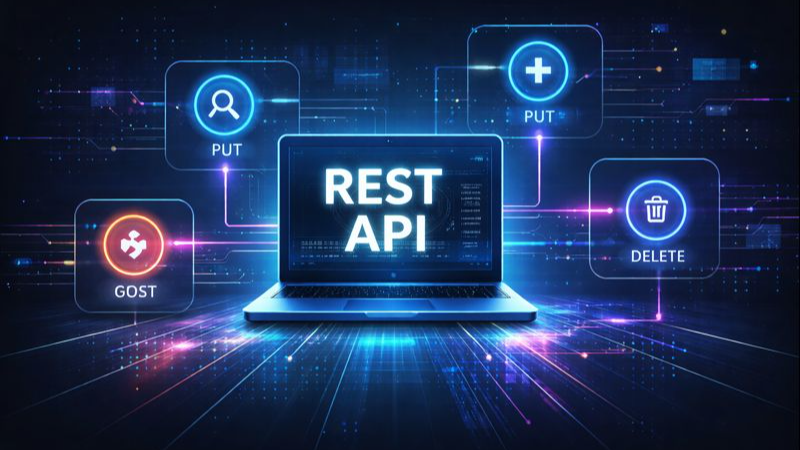
REST API Integration Services – Seamless REST Integration
Original price was: ₹45,000.00.₹30,000.00Current price is: ₹30,000.00.
REST APIs have become the industry standard for enabling communication between software systems. From mobile apps and SaaS platforms to enterprise microservices and cloud-based applications, RESTful APIs provide a lightweight, scalable, and interoperable way to exchange data.
Our REST API Integration Services help businesses design, integrate, and optimize secure, stateless, and high-performance RESTful APIs that scale effortlessly. Whether you are consuming third-party REST APIs or exposing your own services, we ensure robust architecture, clean JSON handling, and enterprise-grade security.
Description
Modern applications rely on REST APIs as the backbone of scalable, high-performance digital systems. From web and mobile applications to enterprise platforms and microservices, REST-based integrations enable fast, reliable, and standardized communication between systems.
Without a properly designed REST API integration, systems face performance bottlenecks, security vulnerabilities, scalability issues, and inconsistent data exchange. Poor implementation can limit growth and degrade user experience.
REST API Integration services provide a structured and secure approach to implementing RESTful API architectures. We enable seamless JSON-based request and response handling, stateless and scalable integrations, secure OAuth and token-based authentication, and high-performance API consumption compatible with modern microservices ecosystems.
⚙️ How REST API Integration Works
Our REST API Integration framework ensures efficient, secure, and scalable communication between distributed systems using industry-standard REST principles.
- 📐 RESTful Architecture Design
- We design clean REST endpoints following standard HTTP methods, resource-based URLs, and best practices.
- 🔄 JSON Request & Response Handling
- All data exchange is handled using lightweight and structured JSON payloads for speed and consistency.
- 🔐 OAuth & Token-Based Authentication
- Secure access is implemented using OAuth, JWT, or token-based authorization mechanisms.
- 📦 Stateless & Scalable Integration
- Each API request is independent, enabling horizontal scalability and high availability.
- 🚀 High-Performance API Consumption
- Optimized API calls ensure low latency, efficient resource usage, and reliable performance.
🌟 Key Features & Benefits
- 📐 RESTful API architecture implementation
- 🔄 JSON-based request & response handling
- 📦 Stateless & scalable integrations
- 🔐 OAuth & token-based authentication
- ⚡ High-performance API consumption
- 🧩 Microservices compatibility
🚀 Business Benefits
- ⚡ Improve application performance
- 📈 Scale systems effortlessly
- 🔐 Secure API access and data exchange
- 🔄 Ensure consistent system communication
- 🧩 Support microservices-based architectures
- 🏗️ Build future-ready applications
🏭 Use Cases & Industries
REST API Integration powers modern digital ecosystems across industries:
- 🌐 Web Applications
- Frontend-backend communication and third-party integrations
- 📱 Mobile Applications
- Secure and scalable API-based mobile backends
- 🧩 Microservices Platforms
- Service-to-service communication using REST APIs
- 💼 Enterprise Systems
- ERP, CRM, and internal system integrations
- 📊 SaaS Products
- API-first product development and integrations
🔍 Comparison: REST API Integration vs Legacy Integration
| Aspect | REST API Integration | Legacy Integration |
|---|---|---|
| Architecture | ✅ RESTful & stateless | ❌ Tightly coupled |
| Data format | ✅ JSON | ❌ XML / Custom |
| Scalability | ✅ High | ❌ Limited |
| Security | ✅ OAuth & tokens | ❌ Basic authentication |
| Microservices | ✅ Compatible | ❌ Not supported |
⭐ Why Choose Our REST API Integration Services
- 📐 Standards-compliant REST architecture
- 🔐 Secure authentication mechanisms
- ⚡ High-performance and low-latency APIs
- 📦 Stateless and scalable design
- 🧩 Microservices-ready integrations
- 🔝 Production-grade implementation
❓ FAQs
What is REST API Integration?
REST API Integration connects systems using RESTful principles, enabling secure, scalable, and standardized communication through HTTP and JSON.
Do you support OAuth authentication?
Yes. We implement OAuth, JWT, and token-based authentication to secure API access.
Is REST API integration scalable?
Absolutely. REST APIs are stateless by design, allowing easy horizontal scaling.
Can REST APIs be used with microservices?
Yes. REST APIs are widely used for microservices communication and system interoperability.
Do you optimize API performance?
Yes. We optimize API calls, payloads, and caching strategies to ensure high performance.
Related products
-
Document Scanning API – Intelligent Document Digitization
Original price was: ₹45,000.00.₹30,000.00Current price is: ₹30,000.00. -
Shipping Rate API – Real-Time Shipping Costs
Original price was: ₹45,000.00.₹30,000.00Current price is: ₹30,000.00. -
AI Chatbot API – Smart Conversational Bots
Original price was: ₹140,000.00.₹100,000.00Current price is: ₹100,000.00. -
Sentiment Analysis API – Understand Customer Emotions
Original price was: ₹45,000.00.₹30,000.00Current price is: ₹30,000.00.






Reviews
There are no reviews yet.